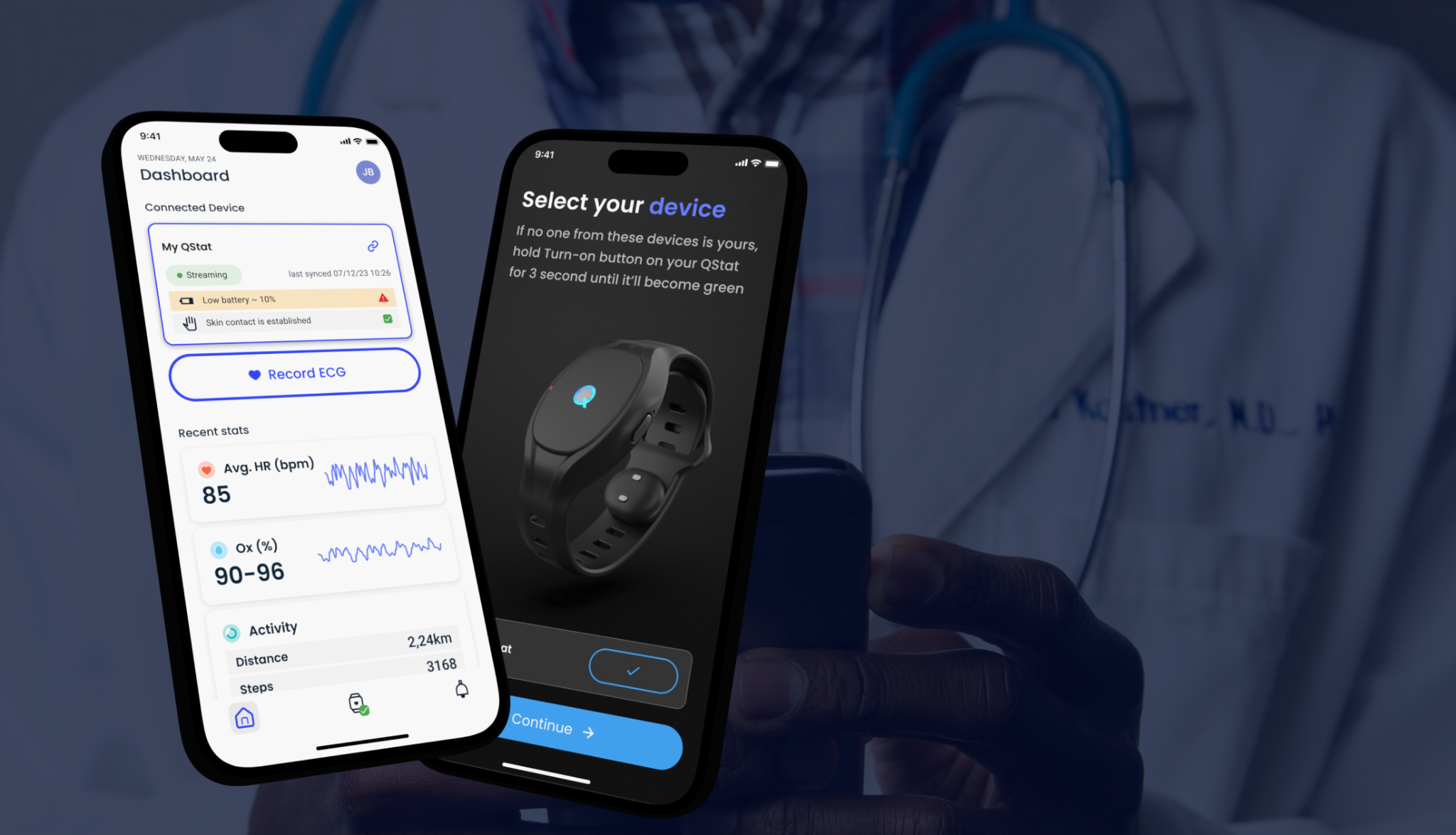
Flutter has quietly moved past the “promising framework” phase. In 2026, it’s simply one of the most practical ways to build modern mobile products, especially when businesses want speed, consistent UI, and a predictable development process across platforms.
What makes Flutter stand out isn’t hype. For many companies, that alone is a strategic advantage: fewer moving parts, faster iteration cycles, and less room for platform drift.
This is why Flutter is no longer used only by startups. Today, it’s widely adopted by companies that need real production-grade applications: subscription platforms, fintech products, healthcare services, marketplaces, delivery systems, and wellness apps. In practice, Flutter fits especially well for businesses that want to ship a polished UI, maintain feature parity between platforms, and stay agile as the product evolves.
If you’re trying to understand the financial side of this decision, we have a dedicated breakdown in our guide on How Much Does It Take to Develop a Flutter App in 2026. That article complements this one by helping you model expected cost ranges before choosing the right team structure.
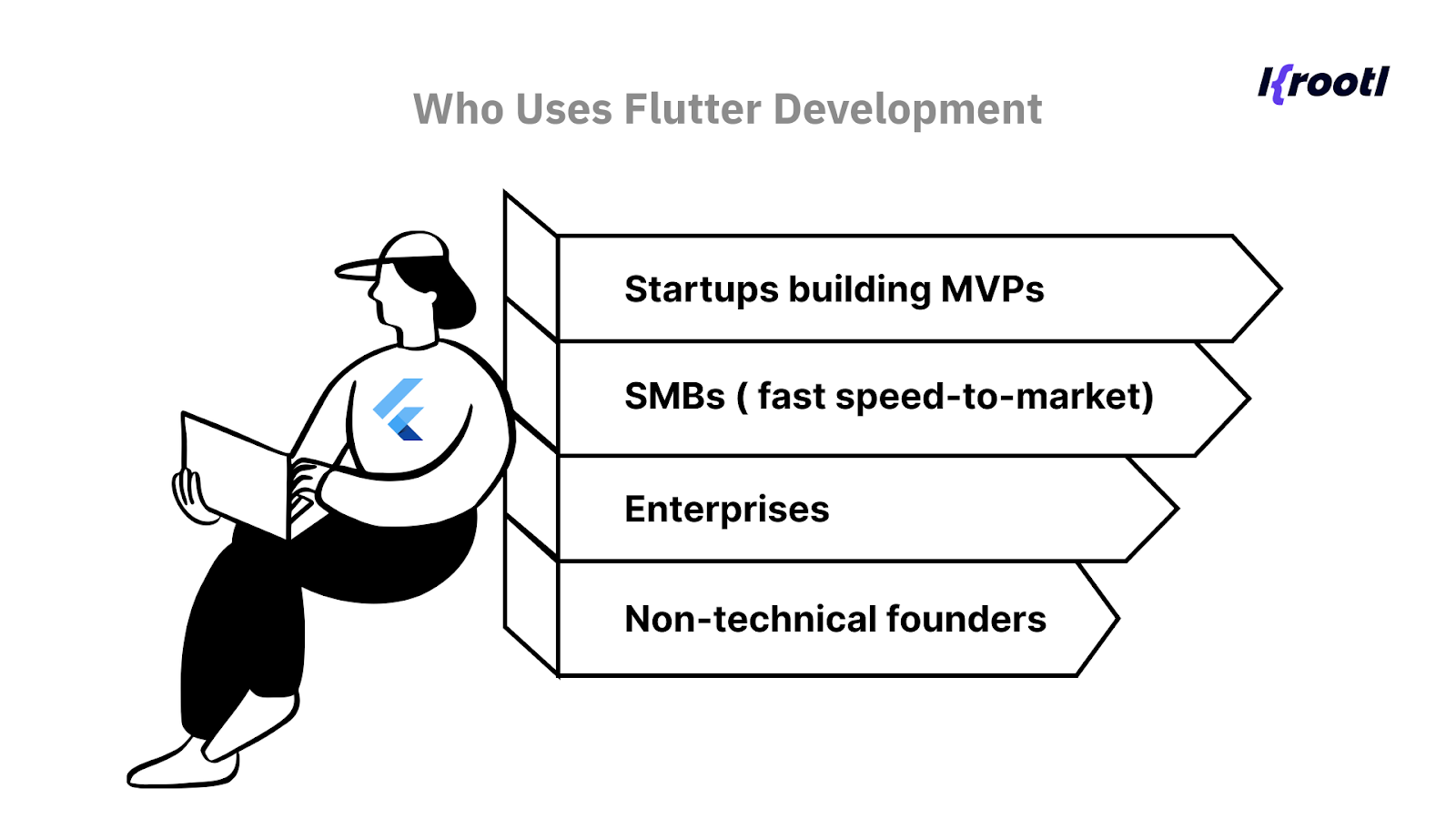
The range of teams using Flutter has expanded as well. We see it being used by:
- Startups building MVPs and testing product-market fit fast
- SMBs that need speed-to-market without sacrificing quality
- Enterprises expanding their mobile reach with scalable architecture
- Non-technical founders looking for a trusted partner to build and launch the first version of their product
However, Flutter itself doesn’t guarantee success.
The same Flutter app can turn into a smooth, scalable product or become a slow, expensive rewrite, depending on one key decision: who builds it.
Should you hire a Flutter freelancer? Build an in-house Flutter development team? Or work with a Flutter development agency that provides end-to-end delivery?
This article breaks down those options in a clear, business-first way. We’ll compare Flutter agencies, freelancers, and in-house teams based on real-world factors: cost, speed, control, scalability, and the hidden risks most companies don’t notice until it’s too late.
Where Flutter Works Best: Key Industries and Real Use Cases
One of the easiest ways to understand whether Flutter is the right technology choice is to look at where it consistently performs well in real-world products.
That said, some industries benefit from Flutter more than others, not because of trends, but because of how Flutter handles UI consistency, rapid iteration, and multi-platform delivery.
Fintech Apps
Fintech products typically require clean user experiences, stable performance, and long-term maintainability. These apps also tend to evolve fast: new onboarding flows, compliance-driven updates, analytics improvements, and feature rollouts based on user behavior.
Flutter fits well here because it allows teams to build structured interfaces quickly while keeping design consistency across iOS and Android. It also supports building secure app architectures that scale over time, especially when paired with a well-designed backend and proper release discipline.
A good example is Grassfeld, a Flutter-based personal finance management application focused on user-friendly money tracking and financial organization. Products like this are rarely “one-time builds” - they require ongoing improvements, testing, and refinement, which is exactly where Flutter’s development speed becomes a long-term advantage.
Wellness & Meditation Apps
Wellness apps are all about experience. Users expect smooth animations, clean design, fast navigation, and a calming UI that feels intentional. Flutter is particularly strong in this space because it provides full control over the interface, which allows teams to deliver that “premium feel” without overengineering.
We’ve seen this firsthand while working on WholeBodyPrayer (WBP) - a wellness and meditation product where the user experience isn’t just decoration, it’s part of the value. Flutter made it possible to build a responsive, consistent design system across platforms while keeping development predictable.
Healthcare Platforms
Healthcare apps often combine multiple layers of complexity: user accounts, role-based access, booking systems, reporting, and sometimes integration with external services. Many of them also require strict stability, as bugs aren’t just inconvenient they can break trust.
Flutter works well here because it supports fast development while still allowing clean architecture patterns and long-term maintainability. The key is not Flutter itself, but the team’s ability to structure the product correctly from day one.
HRTech
HRtech products are usually more complex than they appear from the outside. Even a “simple hiring platform” typically includes multiple user roles (candidates, recruiters, HR managers), dashboards, filtering logic, messaging, document uploads, and sometimes integrations with external HR systems.
These platforms also tend to evolve continuously: companies refine their hiring workflows, adjust evaluation logic, add automation, and improve the candidate experience based on feedback. That makes Flutter a strong fit, not only because it speeds up development, but because it helps maintain a consistent interface across devices while keeping the product scalable.
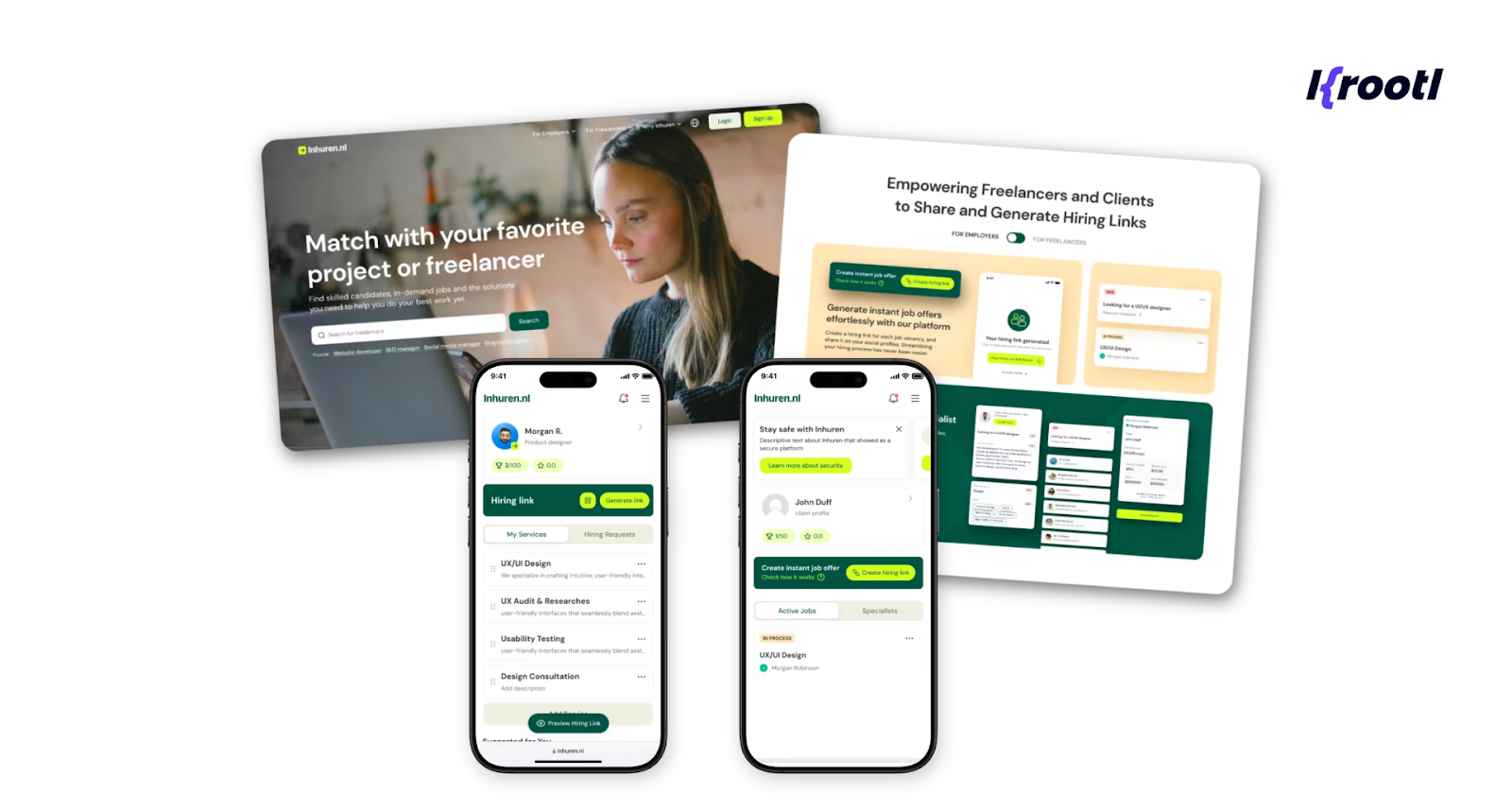
A good example is our Hiring Platform case study, where Flutter allowed us to build a structured, workflow-driven product with a clean UX and a stable foundation for future expansion.
If you’re still validating how the product should generate revenue (subscriptions, employer plans, marketplace fees, etc.), this guide can also help clarify the strategy: Choosing the Right Business Model for Your App.
EdTech and Learning Platforms
Educational apps often require interactive content, progress tracking, multimedia, quizzes, gamification, and community features. They also tend to support multiple user types (students, teachers, admins), which makes the product more complex than it looks at first glance.
Flutter’s ability to reuse UI components and maintain consistent behavior across devices makes it a strong match for EdTech products, especially when the roadmap includes web expansion later.
Delivery Apps
Delivery apps are not only about UI, but they are also workflow-driven. These products often involve real-time tracking, map integration, driver apps, admin panels, push notifications, and operational dashboards.
Flutter is a strong option here because it allows teams to build multi-role systems (courier + customer + admin experience) faster and maintain them as one ecosystem. If you’re thinking about building a delivery solution from scratch, our step-by-step guide on Building Your Own Mobile Delivery App walks through key decisions, architecture considerations, and common pitfalls to avoid.
Why the Hiring Model Matters More Than the Tech Stack
Flutter is mature, fast, and flexible enough for serious application development across industries.
But here’s the reality: choosing Flutter is often the easy part. Choosing the right team model is what determines whether the product succeeds.
Most apps don’t fail because of the framework. They fail because of delivery issues - unclear ownership, inconsistent quality, weak communication, lack of testing, or simply a team that can build screens but can’t build a product.
That’s why your hiring model directly affects the outcomes that matter most:
- Total cost, not just hourly rates
- Speed of delivery, which depends on coordination, not just coding
- Control, which always comes with management responsibility
- Quality, which requires process, not just talent
- Risk, especially when priorities shift or the scope grows
So the real question isn’t “who can code in Flutter.” It’s who can reliably deliver a Flutter product.
Comparison Overview: Flutter Agency vs Freelancer vs In-House Team vs Staff Augmentation
If you’re trying to decide between a Flutter freelancer, an in-house team, a Flutter development agency, or staff augmentation, the fastest way to get clarity is to compare them through a business lens.
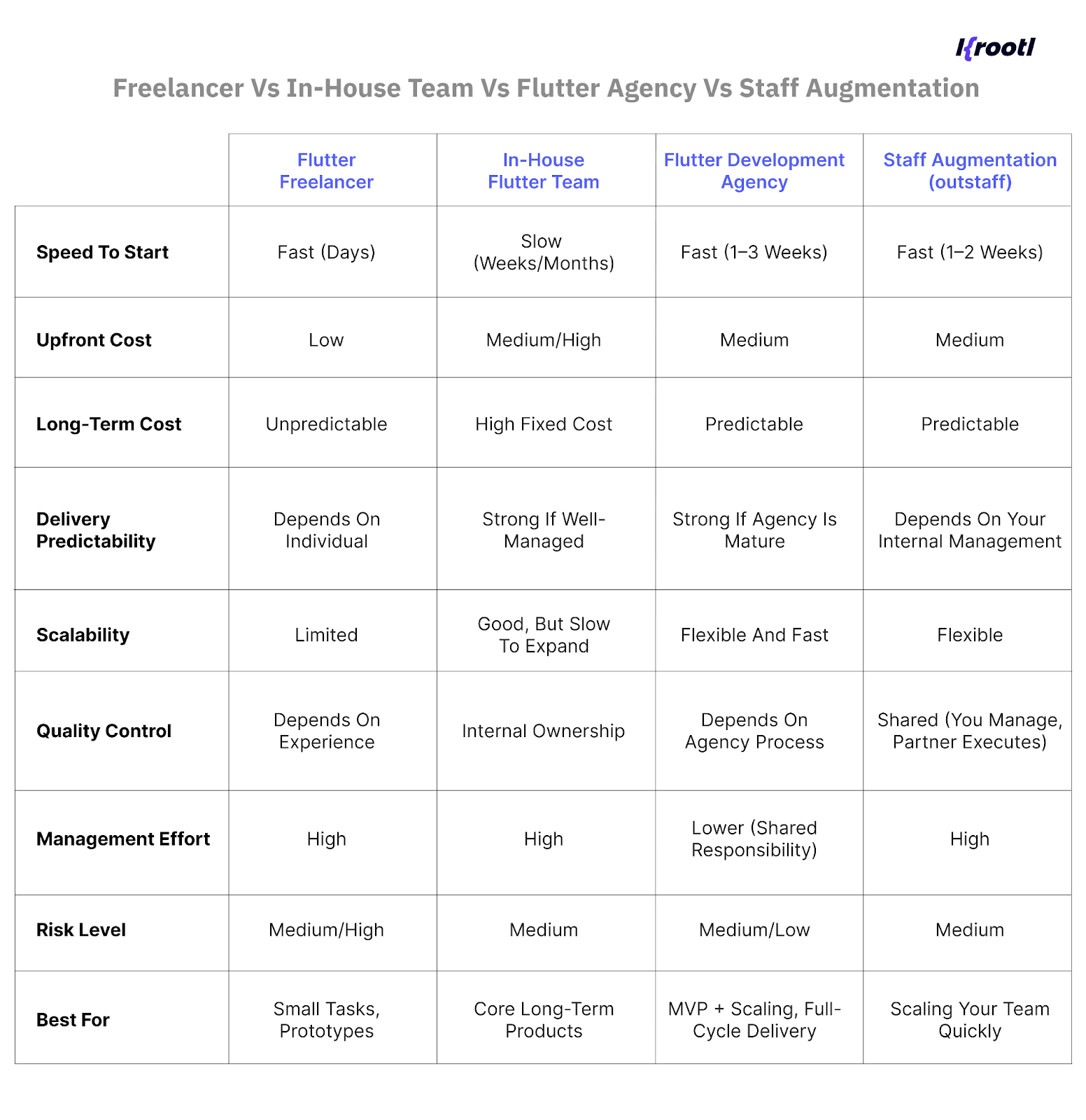
This table gives a quick snapshot, but it doesn’t tell the full story. Freelancers often look like the cheapest option until the scope expands. In-house teams feel like the most stable route until hiring becomes a bottleneck. Agencies can move fast, but only if they operate as a real product delivery team. Staff augmentation sits somewhere in the middle: it gives you extra execution power, but only works well when you already have strong internal ownership.
Let’s break down each option.
Option 1: Hiring a Flutter Freelancer
Hiring a Flutter freelancer is often the fastest way to start building. It’s a common choice for startups, small businesses, and founders who want to validate an idea without committing to a full team.
In the right context, it’s a solid approach. A strong freelancer can deliver quickly, communicate directly, and keep the budget flexible - especially if your scope is limited and your priorities are clear.
When it works best
A freelancer is usually a good fit when you need:
- a prototype or proof of concept
- UI implementation based on existing designs
- bug fixing or small feature extensions
- short-term help to support an internal team
Where the risks begin
The freelancer model becomes fragile once the product grows beyond “one person's scope.” Mobile apps require ongoing iterations, testing, release management, and long-term maintenance. At that stage, the biggest issue isn’t skill - it’s dependency.
The typical risks include:
- single point of failure
- inconsistent availability
- limited scalability
- missing QA and release discipline
Hiring a freelancer can be a smart way to hire a Flutter developer quickly. But if you’re planning a serious product roadmap, you’ll eventually need either a broader Flutter development team or a more structured delivery model.
Option 2: Building an In-House Flutter Development Team
Building an in-house Flutter team is often seen as the “most controlled” option. You hire developers directly, align them with your internal culture, and build long-term ownership over the product.
For companies where mobile is a core part of the business, this can be the right strategic move. An internal Flutter development team can iterate quickly, develop deep product understanding, and support continuous improvement without relying on external partners.
When in-house makes sense
In-house development is usually the best fit when:
- the app is a long-term business asset, not a one-time launch
- you have an established product roadmap
- you can provide strong product leadership and technical direction
- you plan to maintain and scale the platform for years
The trade-off: hiring and retention become part of your product work
In 2026, the challenge is rarely “can we find a Flutter developer?” It’s how long it takes to build a stable team. Hiring is slow, onboarding takes time, and retention becomes a constant concern - especially for senior engineers.
In-house also requires more than just developers. To ship reliably, you’ll still need QA, design support, release management, and often DevOps involvement.
This model gives maximum control, but it also comes with the highest long-term commitment. If you’re not ready to operate development as a full internal function, in-house can become expensive before it becomes efficient.
Option 3: Working With a Flutter Development Agency
A Flutter development agency is often the best option for companies that want to move fast, reduce delivery risk, and avoid building a full internal team from scratch.
Unlike hiring a single developer, working with a Flutter agency usually means you’re getting an established delivery structure: engineers, QA, project coordination, and often UI/UX support. In practice, you’re not only paying for development hours - you’re paying for a system designed to ship and maintain a product.
When a Flutter agency makes the most sense
This model is a strong fit when:
- you need to build a Flutter application and launch quickly
- you want predictable execution without long hiring delays
- your internal team is small (or non-technical)
- you want a full Flutter development team, not just one engineer
- you need long-term support after release
This is why many businesses choose Flutter outsourcing: it allows them to start development within weeks and scale the team up or down depending on the roadmap.
A strong Flutter development agency typically provides full-cycle Flutter development services: product discovery, UI/UX design, development, QA, release, and post-launch iteration.
This is also where agencies like Krootl fit naturally. Krootl is a Flutter app development agency that supports clients end-to-end - from early ideation to App Store launch - and also offers staff augmentation for companies that want to hire a dedicated Flutter developer or extend their internal team without rebuilding their delivery process.
The key risk: agencies vary dramatically
The biggest mistake companies make is assuming all agencies operate the same way. Some teams provide true product delivery. Others are closer to staffing providers with a nicer website.
If you’re trying to find a Flutter agency for a serious long-term product, check Clutch profiles and look beyond portfolios. The difference shows up quickly in how the team handles architecture, testing, communication, and release planning.
Option 4: Staff Augmentation (The Hybrid Approach)
Staff augmentation sits between hiring in-house and full Flutter outsourcing. Instead of delegating the entire product to a Flutter development agency, you selectively add external specialists to strengthen your internal team.
In practice, this means you might hire a Flutter developer (or several) through a partner like a Flutter development agency, but keep product ownership and decision-making inside your company.
If you’re considering this model, we describe how it works in more detail on our Staff Augmentation page, including typical engagement formats and team setup options.
When staff augmentation works best
This model is usually a great fit when:
- you already have a product manager and internal technical leadership
- you need extra execution power to meet deadlines
- you want to scale your Flutter development team quickly without long recruitment cycles
- you want flexibility without committing to full-time headcount
For many businesses, staff augmentation is the fastest way to build a Flutter application while keeping full internal control over priorities and roadmap.
The trade-off: you still need an internal delivery structure
Staff augmentation is effective only when your internal workflow is mature. You still need someone to manage sprints, review work, ensure quality, and handle releases. Otherwise, you may end up with developers working efficiently, but in different directions.
This is why some companies use a hybrid model: combining staff augmentation with support from a Flutter development agency that can also provide QA, architecture oversight, or release management when needed.
When done correctly, staff augmentation gives you the flexibility of outsourcing while keeping the long-term benefits of an in-house team - without turning hiring into a bottleneck.
Hidden Costs People Don’t Consider (Where Most Mistakes Happen)
When businesses compare a Flutter agency vs freelancer vs in-house team, the discussion often starts with hourly rates. But in real application development, the hourly rate is rarely the main cost driver.
The real cost comes from everything surrounding development: coordination, rework, delays, and the ability to ship reliably.
This is where many Flutter projects lose momentum, not because the team is incapable, but because the delivery model wasn’t designed for product growth.
Quality assurance is not “optional later”
Many companies underestimate how much testing is needed to launch a stable app. Even if you hire a great Flutter developer, quality depends on systematic QA: regression testing, edge-case coverage, device testing, and release validation.
Without QA, teams often ship faster in the first month and then spend the next three months fixing production issues.
App Store and Google Play releases take real effort
Publishing is not just “upload the build.” Real releases require versioning, store compliance, privacy policies, permissions review, crash monitoring, and often multiple rounds of re-submission.
This is why experienced Flutter development teams treat release as part of the workflow, not an afterthought.
Communication overhead becomes a hidden tax
Every unclear requirement turns into a delay. Every missing decision creates rework. This happens most often when companies choose Flutter outsourcing or freelancers without having strong product ownership internally.
A common example: a feature is implemented correctly from a technical perspective, but doesn’t match user expectations, because the product goal was not fully defined.
Architecture mistakes are expensive, even if the app “works”
A Flutter app can look fine on the surface and still be built on weak foundations. Poor state management, rushed backend integration, or a missing modular structure can turn future development into a slow, fragile process.
This is the type of problem that rarely shows up in Sprint 1. It shows up later, when the business wants to scale.
“Cheap” development often creates expensive rework
Many companies try to find a Flutter agency based purely on hourly rates. But if the team lacks experience, you pay later through rewrites, missed deadlines, unstable releases, and product quality issues.

In most cases, the lowest hourly rate doesn’t lead to the lowest total cost; it leads to the highest amount of wasted time.
Management time is part of the budget
If you hire freelancers or build an internal team, someone must lead the process. Sprint planning, roadmap clarification, feedback loops, release decisions, QA coordination - this is real work.
If no one owns delivery, even the best Flutter developers will produce fragmented results.
Cost Breakdown: What You’re Really Paying For (Beyond Hourly Rates)
When companies compare a Flutter freelancer, an in-house Flutter development team, or a Flutter development agency, cost is usually the deciding factor. But the most common mistake is treating cost as a simple formula:
hourly rate × hours = budget
In real Flutter app development, the cost is shaped by delivery structure. Two teams may charge the same hourly rate, but one will ship a stable product faster, while the other will generate rework, delays, and technical debt that quietly multiplies the budget.
Freelancer cost: low entry price, higher uncertainty
Freelancers usually offer the lowest starting cost. If you want to hire a Flutter developer quickly for a small scope, this model is often attractive.
But freelancers rarely include the surrounding roles that make delivery efficient: QA, architecture review, release planning, or structured project management. That means the hidden cost is often in your internal time, and in rework when requirements shift.
Freelancers are cost-effective when the scope is clear and the project is short. For long-term products, the budget becomes harder to predict.
In-house cost: stable ownership, high fixed overhead
An in-house Flutter development team creates strong long-term control. But it also comes with fixed operational costs that many companies underestimate: salaries, taxes, hiring fees, onboarding time, management overhead, equipment, and retention risk.
The cost is not only financial, it’s also time. Hiring a senior Flutter developer can take months, and your roadmap may stall while you search for the right people.
In-house makes financial sense when mobile is core to the business, and the product roadmap is stable enough to justify long-term investment.
Flutter agency cost: higher visibility, better predictability
A Flutter development agency usually costs more than a freelancer per hour, but the pricing model is often easier to forecast. Instead of paying for isolated coding tasks, you pay for a structured delivery team with established processes.
This is why many companies choose Flutter outsourcing when they need predictable execution. A good Flutter agency will include the roles that protect delivery: QA, team coordination, technical oversight, and release management.
In other words, you’re not only paying for developers, but you’re also paying to reduce risk.
Staff augmentation cost: flexible scaling, still needs leadership
Staff augmentation often looks like a middle ground. You can scale your Flutter development team quickly, but without outsourcing the entire product.
The cost here is usually transparent, but the outcome depends on internal management. If your company already has a strong product owner and technical direction, staff augmentation can be one of the most efficient ways to build a Flutter application.
If not, you may end up paying for developers who are productive - but not aligned.
Geography & Rates: Flutter Outsourcing in 2026
When companies explore Flutter outsourcing, geography is often one of the first filters. Many teams start by comparing regions and asking where they can find the “best hourly rate” to hire a Flutter developer.
And yes - rates still vary significantly between markets.
Typical Flutter Developer Rates by Region (2026)
Hourly rates for Flutter app development depend on region, market maturity, seniority, and communication standards. Below is a simplified view of what businesses typically see when trying to hire Flutter developers globally:
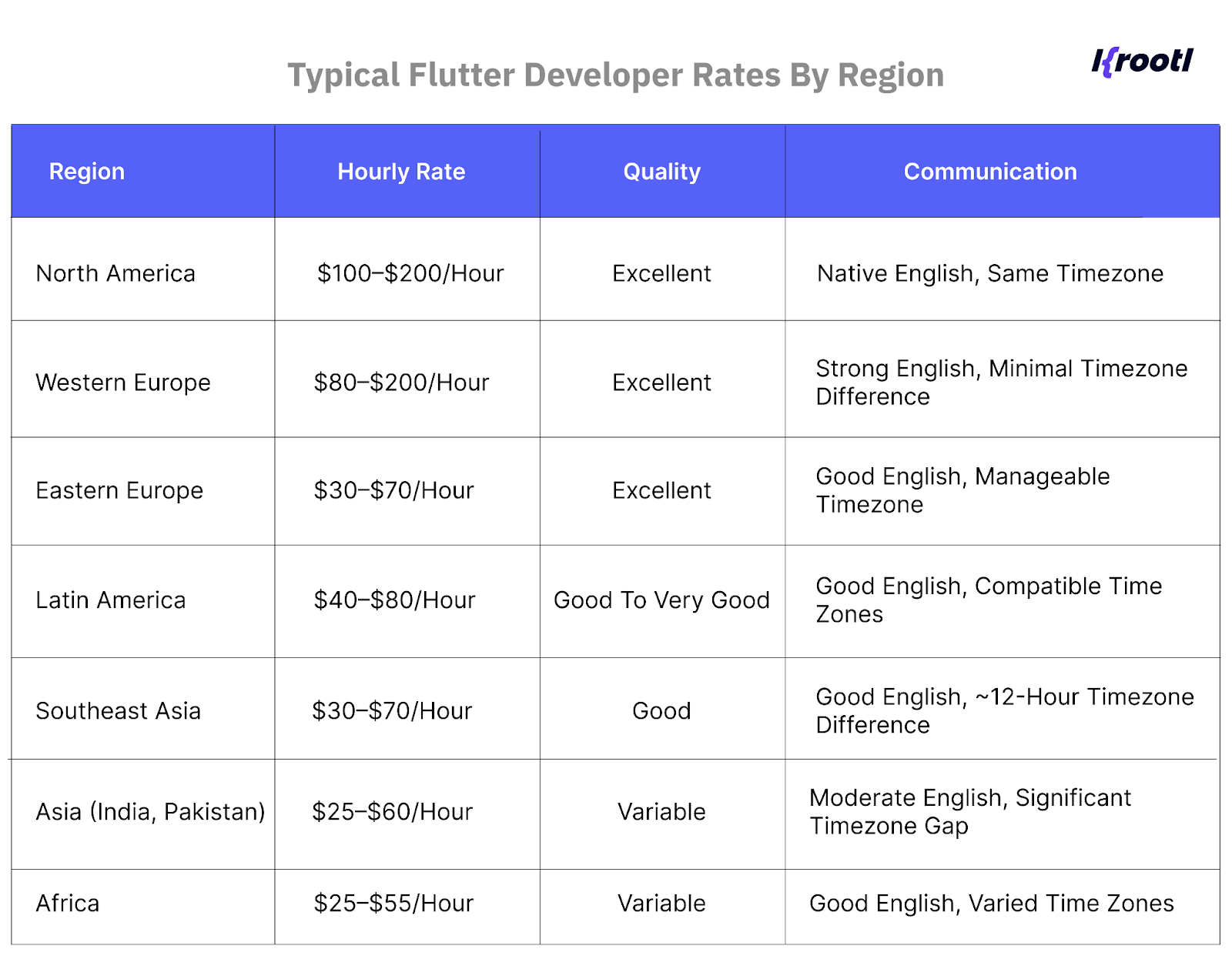
These ranges are useful when budgeting, but they can be misleading if they’re treated as the main decision factor.
Why lower rates don’t always mean lower total cost
A lower hourly rate can look attractive on paper, but the total project cost often increases when:
- requirements are misunderstood
- documentation is weak
- code quality requires rework
- releases are delayed
- testing is inconsistent
- product decisions take too long
This is especially common when companies try to find a Flutter agency based purely on price, without evaluating how the team operates.
The real outsourcing advantage: faster access to strong teams
The main value of Flutter outsourcing is not cost savings. It’s the ability to quickly access experienced specialists and assemble a reliable Flutter development team without spending months on recruitment.
This is why many startups and SMEs choose a Flutter development agency: they get predictable delivery, a ready-to-run workflow, and a team that can scale depending on product priorities.
Time zones and communication still matter
Even with modern tools, time zones affect speed. If your product team and development team can’t sync regularly, decision-making slows down, feedback cycles stretch, and small issues turn into week-long delays.
This is one of the reasons why companies often choose nearshore Flutter development teams: not because they’re cheaper, but because collaboration feels more natural and consistent.
What to focus on instead of “country rankings”
If your goal is to build a Flutter application that survives beyond the MVP stage, the most important factors are:
- team structure (do they include QA and delivery ownership?)
- technical maturity (architecture, testing, release discipline)
- product thinking (can they ask the right questions?)
- communication clarity and speed
Strategic note: the lowest hourly rate doesn’t always mean the lowest total cost. Communication challenges, quality issues requiring rework, and project management overhead can easily eliminate the savings.
Rates matter. But execution matters more.
At the end of the day, the best Flutter outsourcing decision is rarely the cheapest one - it’s the one that helps you ship a stable product with fewer surprises.
Typical Responsibilities of a Flutter App Developer
When businesses decide to hire a Flutter developer, whether freelance, in-house, or through a Flutter development agency, they often assume the role is mostly about “building screens.”
In reality, Flutter app development is broader than UI. A strong Flutter developer is responsible for building a stable foundation that supports future growth, performance, and maintainability.
Below are the responsibilities that typically define a real production-level Flutter role.
Core responsibilities in Flutter app development
A Flutter developer usually works on:
- UI implementation and responsive layouts
Turning Figma designs into clean, pixel-accurate interfaces that work across different screen sizes. - State management and app architecture
Setting up a scalable structure (Bloc, Riverpod, Provider, etc.) so the app doesn’t become fragile as new features are added. - Backend integration and API handling
Connecting the app to backend services, managing authentication flows, handling errors, and ensuring reliable data sync. - Performance optimization
Preventing UI jank, optimizing rendering, improving loading speed, and reducing unnecessary rebuilds. - Local storage and offline behavior
Building stable caching logic and supporting offline-first features when needed. - Third-party integrations
Payments, maps, analytics tools, push notifications, Firebase services, crash reporting, and more. - Testing and stability work
Writing unit tests and integration tests (or supporting QA workflows), fixing edge cases, and ensuring predictable app behavior. - Release support and maintenance
Supporting App Store / Google Play release cycles, fixing production issues, and keeping dependencies updated.
How to Interview a Flutter Developer (or Team)
In 2026, it’s common to find people who list Flutter on their profiles. The real test is understanding whether they can deliver a stable, maintainable product, not just implement UI screens.
A strong interview should focus on:
- real project ownership
- architecture and scalability
- testing mindset
- release experience
- communication clarity
For a detailed checklist and deeper hiring flow, see:
How to Hire a Flutter Developer: A Complete Guide
If you’re interviewing a Flutter agency, don’t focus only on portfolios. Ask about the process: who owns QA, how estimations are done, and how releases are managed.
Final Recommendation: Which Option Is Best?
If you’re choosing between a freelancer, an in-house Flutter development team, a Flutter development agency, or staff augmentation, the best option is the one that matches your execution reality - not the one that looks best on paper.
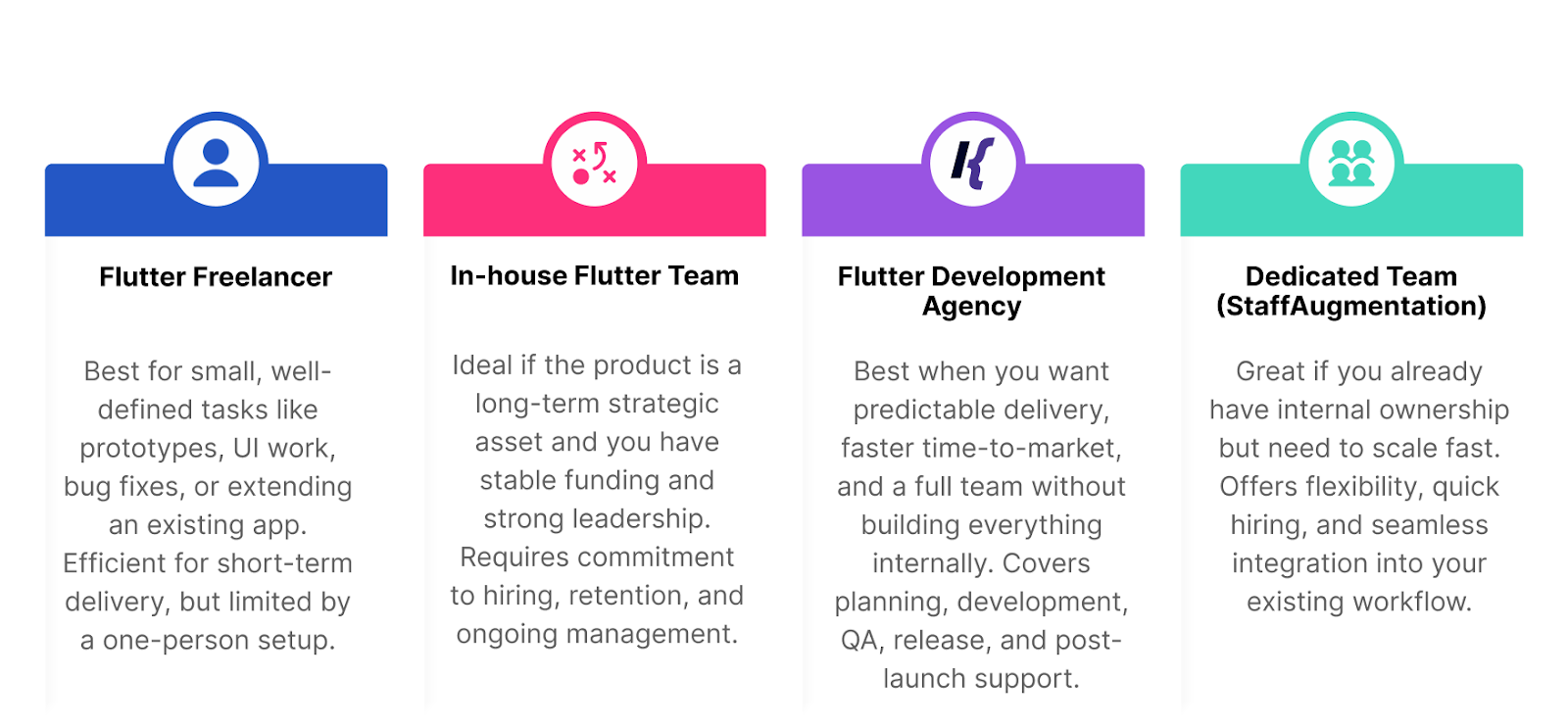
Flutter freelancer
Works well for a small, well-defined scope that needs quick execution. This works well for prototypes, UI implementation, bug fixing, or extending an existing app.
If your main goal is to hire a Flutter developer for short-term delivery, a freelancer can be efficient- as long as you accept the limits of working with a one-person setup.
In-house Flutter Team
Makes sense when your product is a long-term strategic asset, and you’re ready to operate development internally. In-house works well when you have stable funding, strong product leadership, and a roadmap that requires continuous iteration over the years.
The trade-off is commitment: hiring, retention, and management become part of your operational workload.
Flutter Development Agency
A really good fit when you want predictable delivery, faster time-to-market, and a full team structure without building everything internally. For most startups and SMEs, this is often the most realistic path to building a production-ready Flutter application in 2026.
A mature Flutter development agency typically covers not just coding but also planning, QA, release management, and post-launch iteration, reducing risk and making budgeting more stable.
This is the model many businesses choose when they want to outsource Flutter development while keeping the process professional and structured.
Flutter Staff Augmentation
Good when you already have internal ownership (product manager, CTO, or tech lead), but need to scale your Flutter development team quickly. Staff augmentation is ideal when you want flexibility, fast hiring, and direct integration into your internal workflow.
It’s one of the smartest models for companies that want to grow capacity without growing permanent headcount.
Where Krootl fits in this picture
Krootl is a Flutter app development agency that supports businesses through full-cycle application development - from ideation and product discovery to UI/UX design, Flutter development, QA, launch, and long-term support.
At the same time, we also work in a staff augmentation format when companies want to hire a dedicated Flutter developer or extend their internal Flutter development team with experienced engineers.
In other words, whether you need a full delivery team or just additional execution power, the goal is the same: helping you build a Flutter application that ships cleanly and scales without painful rewrites.
There’s no universal “best” choice, but there is always a best choice for your stage, your team structure, and your delivery expectations.
Wrapping Up
Choosing between a Flutter freelancer, an in-house team, a Flutter development agency, or staff augmentation is ultimately about execution - not titles. The best model is the one that matches your roadmap, internal capacity, and how much delivery risk you’re willing to carry.
Ready to Build With Flutter? Drop us a line we’ll be happy to discuss your product and suggest the most practical development approach.