Launching a mobile app is only the beginning of its lifecycle. Once real users, infrastructure, third-party integrations, OS updates, and regular releases enter the picture, maintenance becomes an ongoing part of mobile app development — and one that is easy to underestimate when planning the initial budget.
So, how much does it cost to maintain an app in 2026?
There is no universal monthly figure. A stable application that only needs occasional updates may require a relatively small support budget, while a growing product with complex infrastructure, payments, integrations, and frequent releases may need continuous engineering involvement.
In this guide, we'll break down what mobile app maintenance costs actually include, what affects them, and when increasing maintenance costs might indicate a deeper technical problem.
How Much Does Mobile App Maintenance Cost in 2026?
As a general budgeting benchmark, companies often allocate around 15-25% of the initial development cost per year to maintaining a mobile application. However, this percentage should be treated as a starting point rather than a fixed rule. Current 2026 estimates vary considerably depending on the product's complexity, number of platforms, infrastructure, integrations, security requirements, and frequency of updates.
Current market estimates illustrate just how wide that range can be. Simple applications may require roughly $1000-$2000 per month, while mid-size products can fall around $1000-$6800 per month. Complex or enterprise applications with demanding infrastructure, security, and continuous engineering requirements can cost significantly more.
But complexity isn't the only factor. The way maintenance is organized also matters.
For example, Krootl offers two support models. Retainer-based support starts at $1000 per month for products that require predictable ongoing attention, while ad-hoc support is billed at $35-45 per hour for more stable production products with occasional maintenance needs.
This is why it is useful to separate ongoing maintenance from the initial mobile app development cost. Development gets the product to market. Maintenance keeps it stable, secure, compatible, and usable once the environment around it starts changing.
What Does Mobile App Maintenance Actually Include?
Mobile application maintenance is sometimes understood simply as fixing bugs after launch. In reality, keeping a production app healthy involves considerably more.
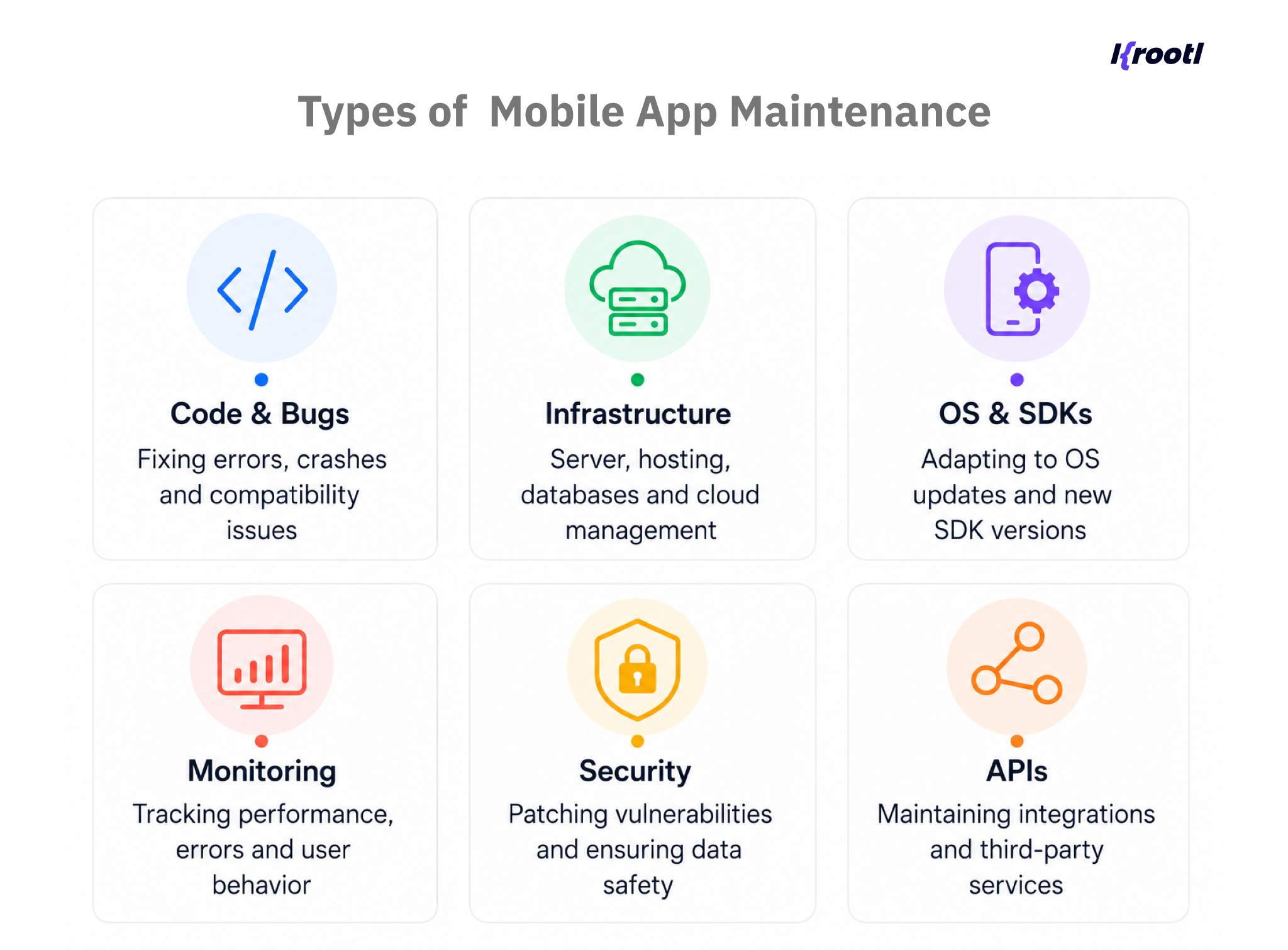
Operating systems change. Libraries and SDKs release new versions. Third-party APIs evolve. Infrastructure needs to accommodate changing traffic. Security vulnerabilities appear. And users inevitably discover scenarios that didn't surface during development.
At Krootl, ongoing maintenance can include software and library updates, application health checks and speed optimization, compliance with changing web and mobile standards, UX improvements, security improvements, and backups.
Bug Fixes and Performance Monitoring
Even a stable application will eventually encounter production issues.
Crash reporting and performance monitoring help identify problems such as slow API responses, unexpected errors, memory issues, and performance bottlenecks. But monitoring itself is only part of the cost: an engineer still needs to investigate the cause, implement a fix, test it, and safely release the update.
Backend, Infrastructure, and Hosting
The app hosting cost can vary dramatically depending on how the product is built and how it is used.Databases, servers, storage, backups, cloud functions, content delivery, staging environments, monitoring, and logging may all contribute to the monthly bill. As the number of users and volume of data increase, infrastructure costs can grow with them.
This is why two applications that appear similarly complex from a user's perspective can have very different ongoing costs.
OS, SDK, and Dependency Updates
A mobile app doesn't operate in a static environment. New iOS and Android releases can affect permissions, notifications, authentication, payments, background processes, and other platform-specific behavior. Libraries and SDKs also evolve, while older versions can eventually become deprecated or introduce security and compatibility risks.
Regular smaller updates are generally easier to manage than allowing several years of technical changes to accumulate.
Minor Product Improvements
Maintenance and new feature development aren't exactly the same thing.
Small UX improvements, compatibility changes, performance optimization, and minor adjustments can reasonably fall within ongoing support. A completely new user flow, major integration, or new product module should usually be scoped and estimated as development work separately.
Security and Compliance
Security doesn't stop being a development responsibility after launch.
Dependencies need patches, access permissions need to remain controlled, infrastructure needs monitoring, and sensitive information needs to be protected throughout the product lifecycle. This becomes particularly important for products operating in industries such as healthcare and fintech, where security and compliance requirements can add another layer of ongoing work.
Third-Party APIs
Payments, authentication, maps, analytics, push notifications, messaging, email, AI services, and other external tools introduce both subscription costs and additional maintenance requirements.
Providers can change their pricing, APIs, SDKs, authentication methods, or technical requirements. Every additional integration therefore creates another dependency that needs to remain compatible with the product.
What Determines Your Mobile App Maintenance Cost?
There is a reason why the answer to “How much does it cost to maintain an app?” varies so widely.
Product complexity is one of the most obvious factors. Payments, messaging, real-time functionality, media processing, multiple user roles, sophisticated business logic, and admin systems all create additional components that need to remain operational.
The number of platforms matters too. Maintaining separate native iOS and Android applications can require duplicated implementation and testing work. Cross-platform development can reduce some of this duplication, although both platforms still need to be tested and kept compliant with their respective requirements.
Backend complexity and traffic influence infrastructure spending. A small application with predictable usage has very different requirements from a platform processing thousands of sessions, transactions, or real-time events.
Third-party integrations introduce dependencies that your development team doesn't fully control.
And then there is technical debt. If poorly structured code makes every small change risky, your maintenance budget gradually stops paying for keeping the product healthy and starts paying for problems in its foundation.
Hidden App Maintenance Costs Businesses Often Miss
Development hours and hosting are relatively easy to see on an invoice. Other ongoing app costs are easier to overlook.
They can include:
- cloud storage and backups;
- monitoring and crash-reporting tools;
- analytics platforms;
- paid APIs and SaaS subscriptions;
- app store and developer account fees;
- QA across devices and OS versions;
- security and dependency updates;
- emergency production fixes;
- unused or inefficient cloud resources;
- engineering time spent understanding poorly documented legacy code.
There is also a less obvious cost: lost product knowledge.
If the only developer who understands a particular part of the system leaves and the product has little technical documentation, even a simple issue can suddenly take much longer to investigate. Documentation and continuity therefore affect the economics of maintenance as much as the quality of the code itself.
Not Sure Where Your Maintenance Budget Is Going?
We’ll review your app and identify where you may be spending more than necessary.
Get a second opinion →
Retainer vs. Ad-Hoc App Maintenance: Which Model Is Better?
Not every production application needs a developer working on it every day.
The right app maintenance services model depends on how mature the product is, how frequently it changes, and how predictable its support requirements have become.
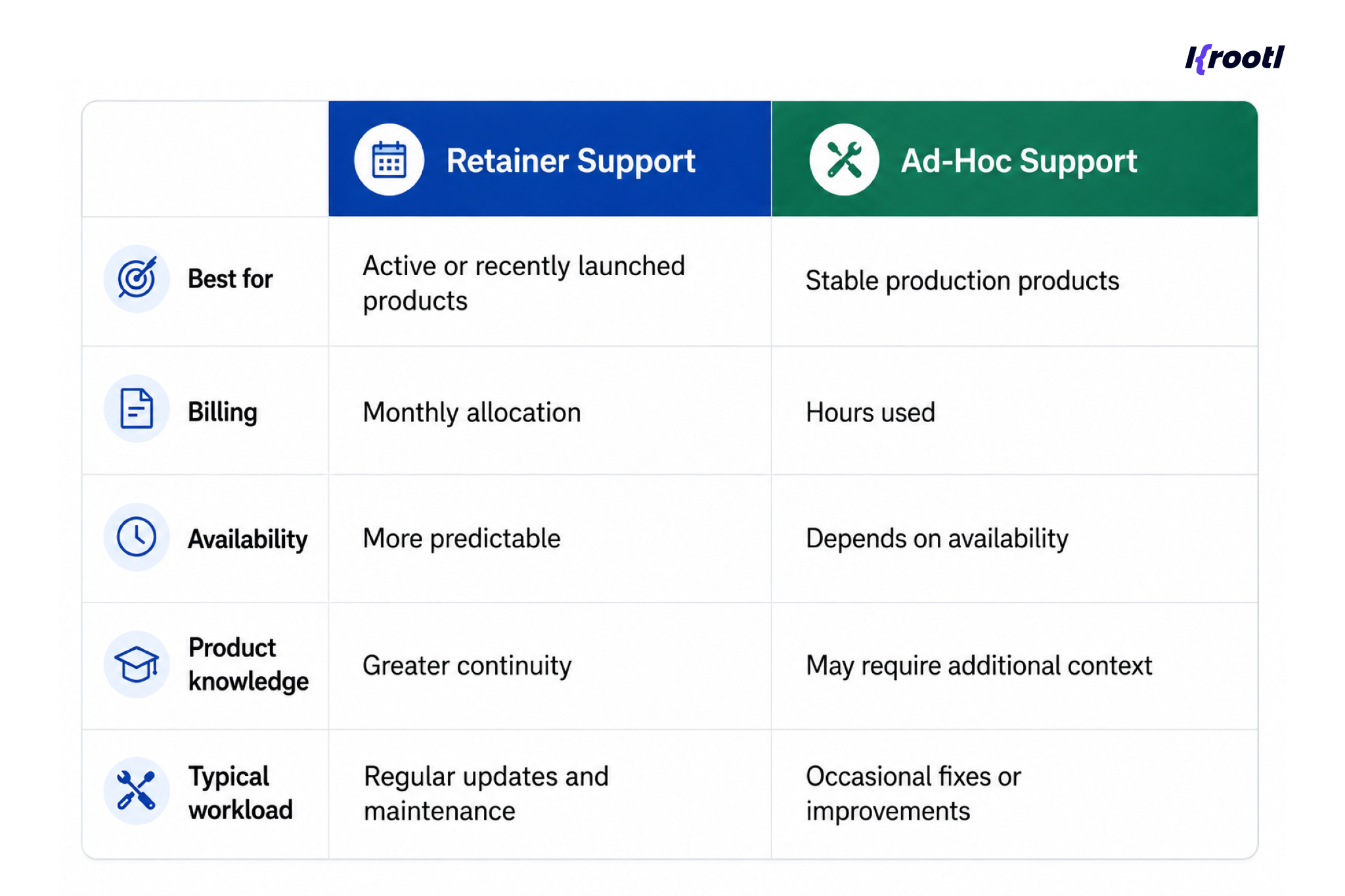
A retainer reserves engineering capacity for the product. One of its main advantages is continuity: the app can be supported by a developer already familiar with how it works, reducing the time required to understand each new issue. This is also how Krootl currently structures its retainer-based support.
Ad-hoc support provides greater flexibility when maintenance needs are occasional. You request engineering resources when something needs attention rather than reserving a fixed amount every month. The trade-off is that resource availability may create a delay before an engineer can start working on the request.
Neither model is universally better. A recently launched product receiving frequent updates has very different needs from a mature application that changes only several times per year.
Why Does Mobile App Maintenance Get More Expensive Over Time?
A growing maintenance budget isn't necessarily a problem.
If your application now has more users, processes more transactions, stores more data, and supports considerably more functionality than it did two years ago, higher operating costs can simply reflect product growth.
The more concerning situation is when maintenance costs increase while development becomes slower.
A common pattern looks something like this:
More features → More dependencies → More integrations → More testing → More technical debt → Slower releases → Higher maintenance cost
At that point, adding more maintenance hours may not solve the underlying problem.
The architecture may need refactoring. Dependencies may need modernization. Infrastructure may have accumulated inefficiencies. Or the current technology may no longer support where the product needs to go next.
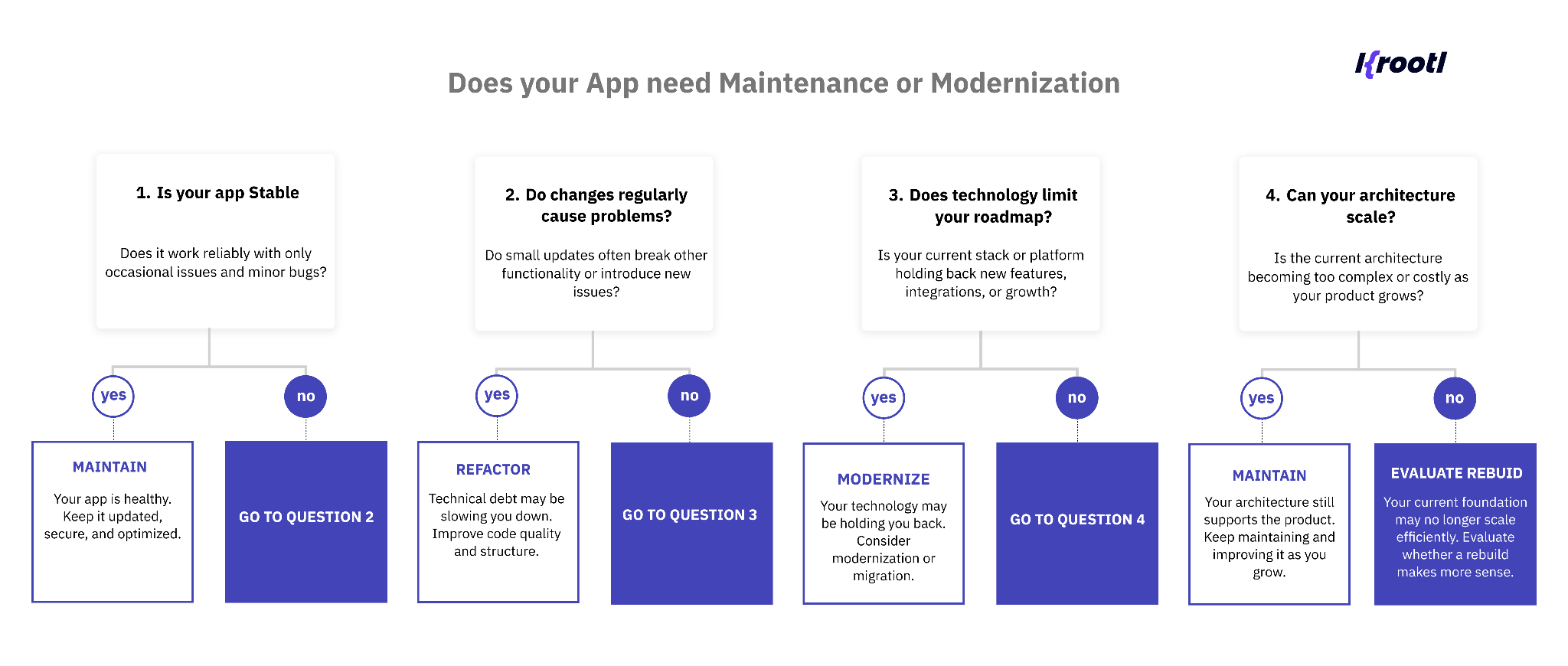
That's where it becomes important to distinguish between maintenance, refactoring, and app modernization.
Maintenance, Refactoring, or Modernization: What Does Your App Actually Need?
Not every expensive application needs to be rebuilt.
Before making a major technical decision, look at what is actually happening inside the product.
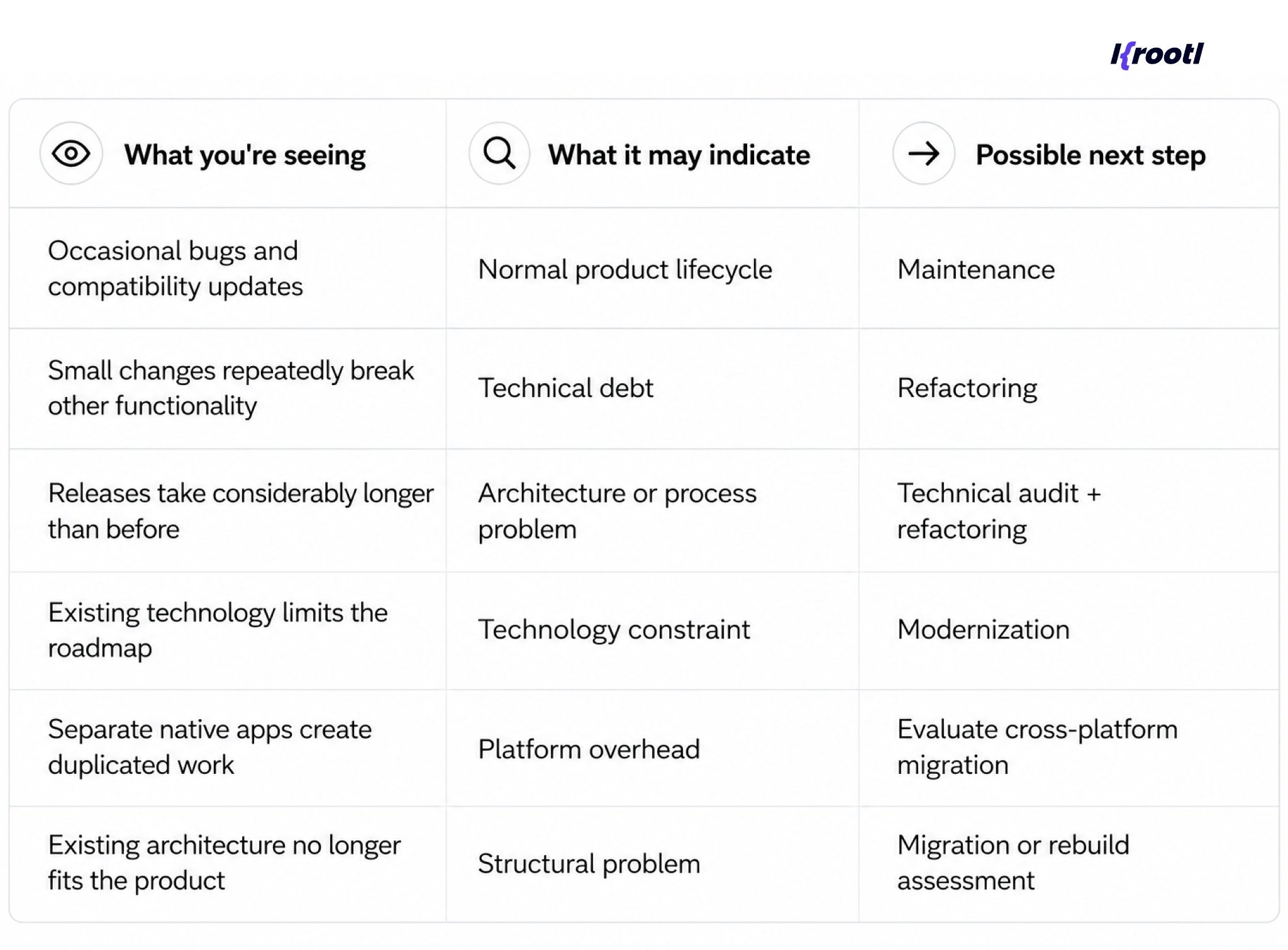
The important thing is not to confuse an expensive maintenance month with a fundamentally unhealthy application.
But if technical debt consistently makes development slower and more expensive, it can eventually become more economical to address the cause than to continue paying for workarounds.
And if the problem is also connected to the current vendor or development setup, an app handover to a new development team can be treated separately from the technology decision. A new team should first audit what already exists and determine what is worth keeping before recommending a migration or rebuild.
Can Flutter Reduce Mobile App Maintenance Costs?
Sometimes, particularly when a significant part of the maintenance budget comes from supporting two separate mobile codebases.
With separate native iOS and Android applications, the same product functionality may need to be implemented, tested, and maintained twice. A shared cross-platform codebase can reduce some of that duplication and make it easier to keep releases aligned.
This is one of the potential long-term advantages of Flutter app development. It can be particularly relevant when an existing product is already due for modernization and the business wants to simplify future cross-platform development.
But moving to Flutter solely because you want to reduce the monthly maintenance bill isn't enough reason for a technology migration.
The existing architecture, native functionality, backend, roadmap, migration cost, and expected lifetime of the product should all be evaluated first. Sometimes keeping the current stack and fixing specific architectural problems will be considerably more economical than migrating the application.
The question should therefore be:
Which technical setup gives this particular product the lowest sustainable cost of ownership, not simply the lowest development cost today?
How to Reduce App Maintenance Costs Without Hurting the Product
Reducing maintenance costs shouldn't mean simply doing less maintenance. Postponing necessary technical work can make the eventual fix considerably more expensive.
Instead, focus on reducing unnecessary work and preventing avoidable problems:
- Keep dependencies reasonably current. Regular smaller updates are usually easier than a major upgrade after years of neglect.
- Monitor crashes and performance continuously. Finding issues early reduces the likelihood of expensive emergency fixes.
- Automate repetitive testing and deployment where practical.
- Audit cloud resources and third-party subscriptions. Products often continue paying for services they no longer use.
- Address technical debt incrementally. Don't wait until it blocks the roadmap.
- Maintain technical documentation. Critical product knowledge shouldn't exist only in one developer's head.
- Review the architecture as the product grows. What worked for an MVP may no longer be the right setup at scale.
- Remove functionality that no longer creates value. Every feature adds some long-term maintenance responsibility.
The objective isn't to achieve the lowest possible monthly bill. It is to keep the total cost of ownership under control without sacrificing stability or making future product development unnecessarily difficult.
Who Should Maintain Your Mobile App?
There are several ways to organize mobile app support and maintenance, and the hourly rate is only one part of the decision.
An in-house team provides strong product knowledge and direct access to engineering resources, but it also creates fixed salary, recruitment, management, QA, and infrastructure costs. It tends to make sense when there is enough continuous development work to justify keeping those capabilities internally.
A freelancer can work well for occasional fixes or a narrowly defined technical scope, particularly when the product is relatively small and well documented. The main risk is dependence on one person's availability and knowledge.
A development partner sits somewhere between the two. You don't need to employ every technical role permanently, while still having access to development, QA, project coordination, DevOps, and other expertise when the product requires it.
If you're deciding which setup makes sense for your product, our comparison of Flutter agency vs. freelancer vs. in-house vs. staff augmentation looks at the trade-offs between these models in more detail.
For companies that want to expand the existing team with an individual specialist instead, we've also prepared a guide on how to hire a Flutter developer.
Wrapping Up
The question isn't whether your mobile app will require maintenance after launch. It will.
The more useful question is whether your maintenance budget is keeping a healthy product running or compensating for technical problems that become more expensive every year.
A predictable budget covering monitoring, OS and dependency updates, security, infrastructure, and occasional fixes is a normal part of operating a production application. But continually increasing costs, recurring bugs, slower releases, and an architecture that restricts the roadmap can indicate that routine maintenance is no longer enough.
At that point, the right next step may be targeted application refactoring, mobile app modernization, a technology migration, or even a change in development setup, rather than simply allocating more support hours.
Need Help With Your App Maintenance?
Not sure what your app really needs? We can review your current setup and recommend the right next step.
Frequently Asked Questions
How much does it cost to maintain a mobile app per month?
The monthly cost to maintain a mobile app depends on its complexity, infrastructure, number of integrations, and how frequently it requires updates. As a general benchmark, annual mobile app maintenance is often estimated at around 15-25% of the original development cost, although complex or actively growing products can require a larger budget.
At Krootl, the support model can also depend on how much ongoing attention the product requires. Retainer-based support starts at $1000 per month, while stable production apps with occasional needs can use ad-hoc support at $35-45 per hour.
What does mobile app maintenance include?
Mobile application maintenance typically covers bug fixes, performance monitoring and optimization, software and library updates, compatibility with changing iOS and Android requirements, security improvements, backups, and ongoing infrastructure support.
At Krootl, these areas form part of the ongoing support scope, alongside UX improvements where needed. Major new features, however, should generally be scoped separately from routine maintenance.
How often does a mobile app need maintenance?
Mobile app maintenance is an ongoing process rather than a fixed update schedule. Security issues, OS and SDK changes, third-party API updates, performance problems, or production bugs may require attention even when no new features are being developed.
The appropriate frequency therefore depends on the product. An actively growing app may need engineering attention every month, while a stable production application may only require occasional updates and scheduled health checks.
What happens if you don't maintain a mobile app?
An app doesn't remain technically unchanged just because its code isn't being actively developed. Over time, OS updates, outdated libraries, security vulnerabilities, API changes, and infrastructure requirements can affect performance and compatibility.
Delaying maintenance can also allow technical debt to accumulate, making future updates more difficult and expensive. In some cases, what could have been handled through routine maintenance eventually becomes a larger refactoring or mobile app modernization project.